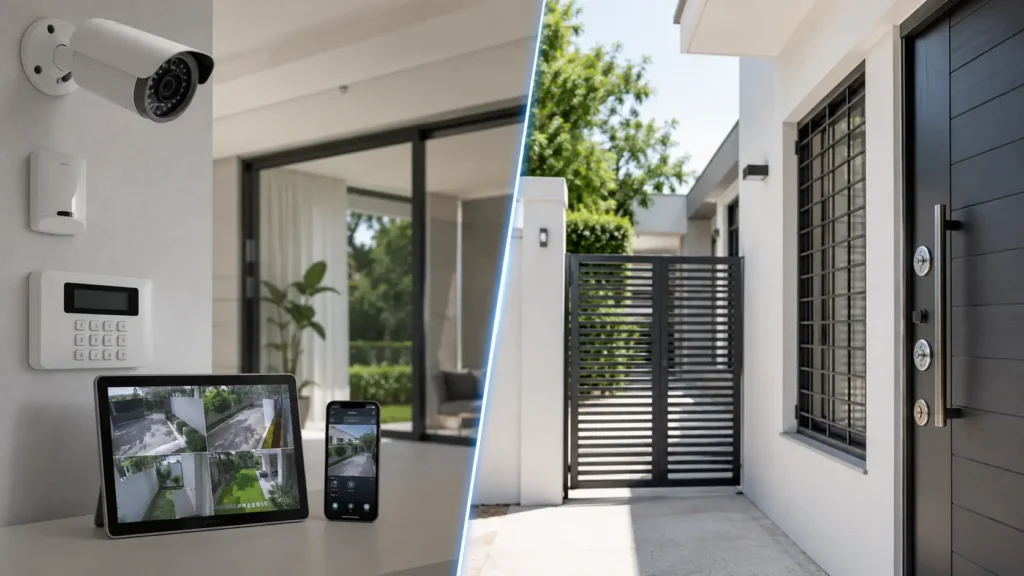
The the difference between active and passive safety lies in the role each plays within a security system. Passive security hinders or delays an intrusion through physical barriers, whilst active security detects an incident, generates alerts and enables a response to be triggered.
Two different ways of protecting a property
Any security strategy combines two basic functions: increasing the building’s resilience and detecting a risk situation. Passive security addresses the former; active security, the latter.
Passive security includes features such as security doors, reinforced locks, grilles, shutters, fencing and security glass. Its purpose is to protect the premises by means of physical barriers that make access more difficult and buy time in the event of an attempted break-in.
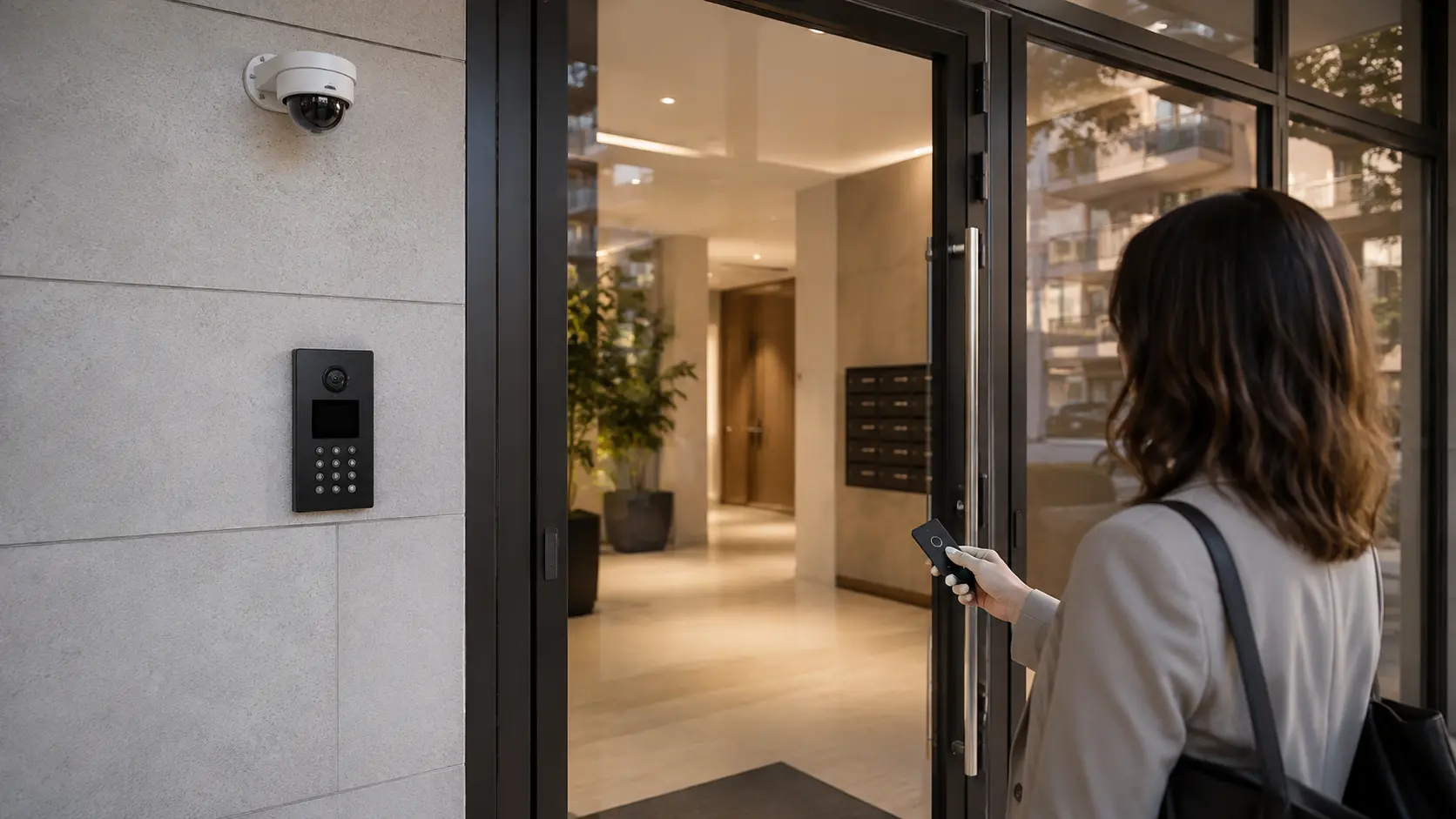
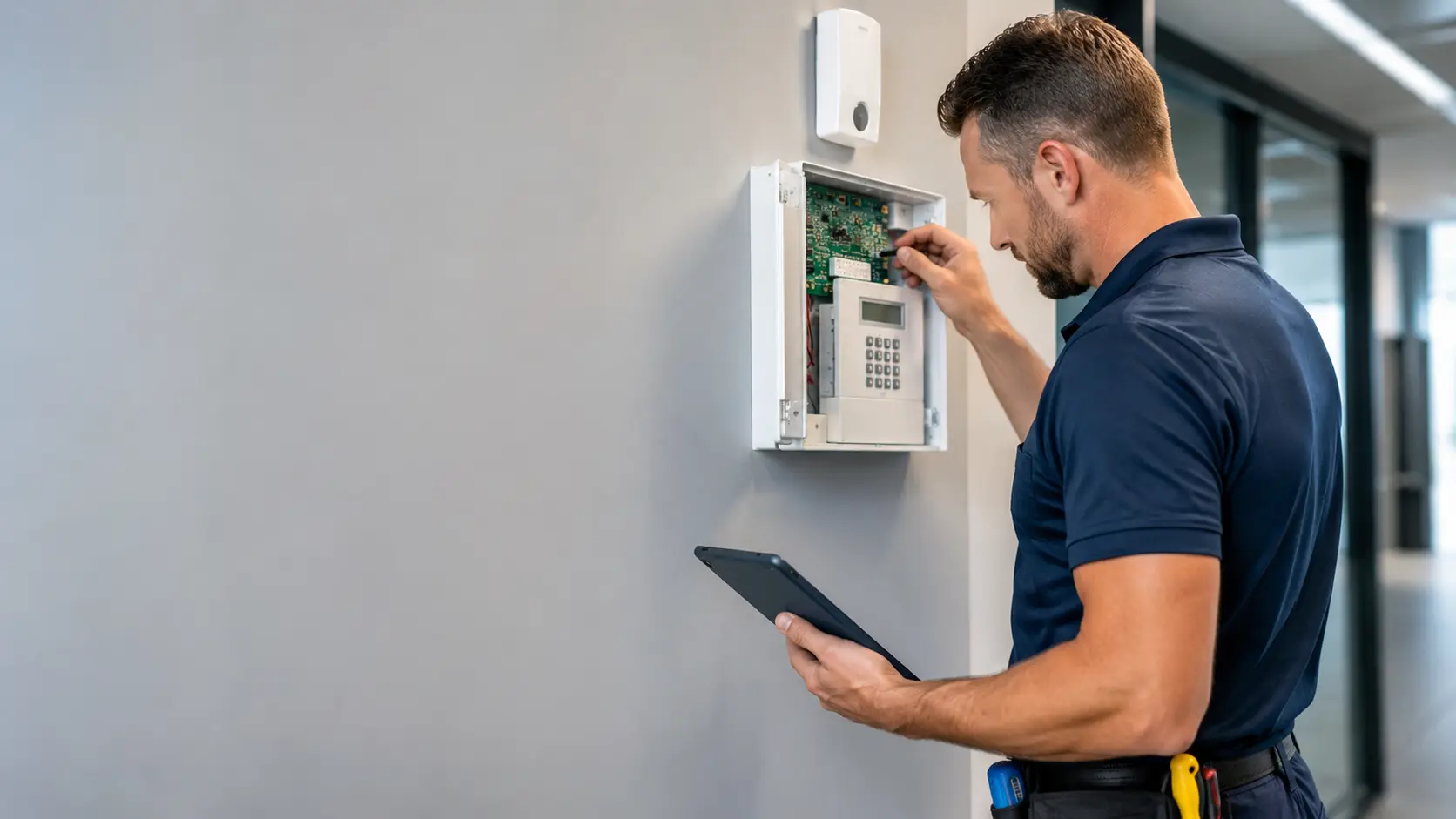
The active safety brings together systems such as alarms, sensors, video surveillance cameras, access control, fire detection or connection to Alarm Reception Centre. Its purpose is to identify high-risk situations and trigger alerts that enable the incident to be managed.
| Appearance | Passive safety | Active safety |
| Main function | To prevent, delay or limit the damage | Detect incidents and trigger alerts |
| Protection class | Physical and structural | Electronics and operations |
| When it takes effect | Before or during the attempted intrusion | When an incident is detected |
| Common examples | Security doors, locks, grilles, shutters, fencing or safety glass | Alarms, sensors, cameras, access control, fire detection or security monitoring centres |
| Main contribution | Save time and improve the property’s durability | It enables you to check the status of an incident and coordinate its handling |
| Limitation | It does not in itself indicate an incident | It requires proper installation and maintenance |
Examples of active and passive safety measures by property type
Active and passive security measures vary depending on the use of the property, its access points, the level of exposure and the activities carried out there. A residential property, a high-street shop or an industrial unit do not present the same risks, so the combination of measures must be tailored to each individual case.
Housing and communities
In homes and residential estates, passive security may include security doors, reinforced locks, security grilles on ground floors, fencing, security glass or barriers at vulnerable entry points. In owners’ associations, it may also apply to entrance halls, garages, storage rooms and communal areas.
These features help to increase the property’s physical security and buy time in the event of an attempted break-in or unauthorised access.
As part of active safety measures, it is common practice to install home alarm systems, motion detectors, video surveillance cameras or perimeter protection in homes with a garden. When the system is connected to a Alarm Reception Centre, the incident can be verified and managed in accordance with the service contracted.
Shops and businesses
Shops and businesses are exposed to specific risks, such as burglary outside opening hours, unauthorised access, theft, vandalism or entry into restricted areas. It is therefore advisable to combine measures that protect both the premises and day-to-day operations.
Security shutters, reinforced shop windows, high-security doors or locks specifically designed for commercial premises can be used as passive security measures. These solutions make it more difficult to gain access and help to protect the premises when they are closed.
As regards active safety, it is common practice to incorporate various types of business alarms, video surveillance cameras, access control in restricted areas and connection to a Alarm Reception Centre to manage incidents. The combination of these measures makes it possible to identify a risk situation at an earlier stage and to act in accordance with the established protocol.
Industrial buildings and facilities
Industrial buildings, warehouses and commercial premises often have multiple entrances, large floor areas, outdoor spaces and loading bays, all of which require specific security planning. In industrial settings in Barcelona and its metropolitan area, this approach can be particularly relevant in industrial estates, logistics centres or facilities operating outside normal working hours.
Passive security measures may include perimeter fencing, reinforced industrial doors, protective bollards or enclosures designed to deter unauthorised access and protect machinery, goods or valuable assets.
As part of active safety measures, these areas are usually complemented by systems such as industrial alarms, video surveillance, perimeter protection, detectors designed for large areas, connected to Alarm Reception Centre. The aim is to detect any incidents at an early stage and to facilitate a more efficient handling of the report.
Why active safety and passive safety are complementary
Active and passive security are complementary because they address different stages of the same incident. One comes into play before an intrusion, by increasing the building’s resistance; the other comes into play when there is a sign of risk that needs to be detected, verified or managed.
This combination allows for the creation of layers of protection. Physical barriers force intruders to expend more time and effort, whilst electronic systems enable us to detect that something is happening and trigger the necessary alerts. The value lies in both measures working together, not in choosing one over the other.
Therefore, an effective professional solution assesses the current level of resilience to determine which electronic systems are needed to address the weak points.
How to implement these measures in a professional security solution
Now that we know the the difference between active and passive safety, the next step is to assess what measures each property actually needs. It is not a question of installing more equipment, but of identifying which physical barriers are already in place, which areas remain vulnerable and which electronic systems can provide additional protection.
At Dumo Security We design active security solutions for homes, businesses, communities and industrial premises in Barcelona and the surrounding area. These may include installation of security alarms, video surveillance cameras or access control depending on the type of property and the level of risk.
These solutions can complement existing passive security measures, such as reinforced doors, window frames, fencing or physical security features. If you need to review the security of your home or business, you can request technical advice to assess which combination is best suited to your situation.
Frequently asked questions about the differences between active and passive safety
Which is better: active safety or passive safety?
It depends on the property and the risk you wish to cover. Passive security is useful for reinforcing entry points and delaying a break-in, whilst active security allows you to know when an incident occurs and to deal with it. In homes, businesses or professional premises, the most effective approach is usually to combine both.
Is an alarm a form of active or passive security?
One security alarm It is an active security system, as it detects a potential intrusion and triggers an alert. If it is also connected to a Alarm Reception Centre, the notice can be handled professionally depending on the service contracted.
Does a security door replace an alarm?
Not necessarily. A security door can delay a break-in, but it does not detect or report the incident. For this reason, in many cases it is advisable to combine it with detection systems, CCTV or a connected alarm system.